![[personal profile]](https://www.dreamwidth.org/img/silk/identity/user.png) tcampbell1000 posting in
tcampbell1000 posting in ![[community profile]](https://www.dreamwidth.org/img/silk/identity/community.png) scans_daily
scans_dailyPart 93b of 105. Warning for arguable cultural insensitivity, more savage fascism, and savage slavery. (But no Vandal Savage.)
When we last left our intrepid heroes, a fascist version of the Bronze Age JLA had taken over its reality, which was bleeding into “ours.” And the late-1993 JLA was getting its asses kicked. Hard. It’s all presented in Jurgens’ usual straightforward way, which gives the evil a chilling banality.

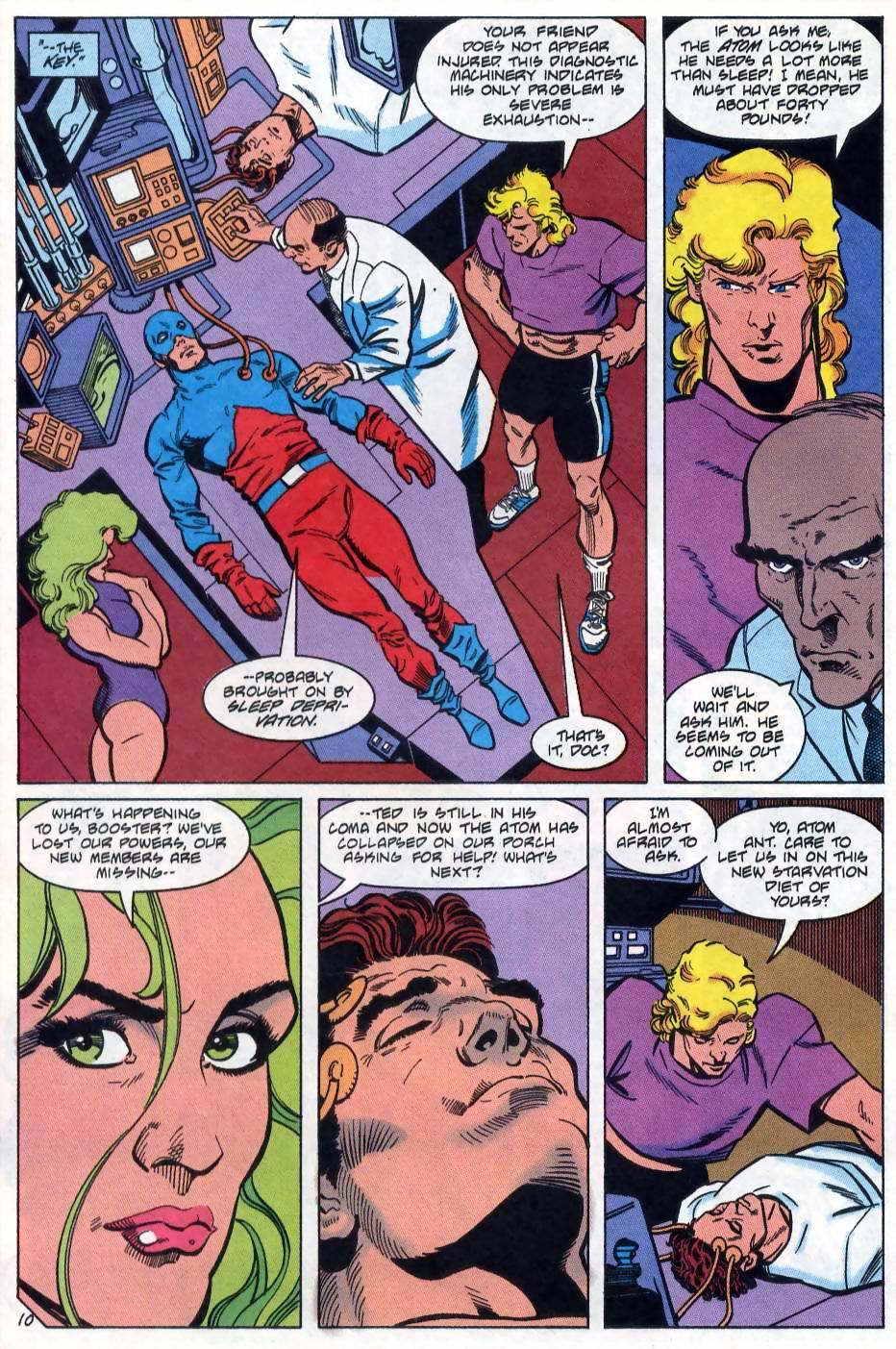
The Atom shows back up on the League’s doorstep in JLA #73-74, but before he can once again tell any current Leaguers that they’re a bunch of losers, he collapses.
Speaking of those losers, Booster and Fire have been hanging out in the basement for the last few issues after concluding that they had no future with the League or as superheroes.

I guess if Max is still giving them room and board, it’s understandable. Most people living in New York would risk regular supervillain attacks just to keep a rent-controlled apartment.
I’m skipping most of the direct League-on-League fights; they’re fun but not the story highlights. Wonder Woman holds her own but surrenders rather than see her teammates killed. Ray and Guy went down to a sneak attack last issue, so Bloodwynd faces a similar choice and picks a different option, vanishing from sight.
He then hooks up with one renegade Fascist Leaguer and a villain sprung from jail. Bloodwynd uses his “mysterious” self-disguising powers (invisibility? Shape-shifting? Who could he be?) to pose as Hawkman and bring the other two in as “prisoners.” They enter the League megaprison where Real Leaguers are being held. The horrific brutality they find there speaks for itself.

There’s another fight. Other than fascism, the Fascist League only differs from the old one in a few ways, but one difference is that Fascist Martian Manhunter is more self-aggrandizing than Charlie Sheen in his “tiger blood” interview. This catches up to him here (to Fash MM, not Sheen)…

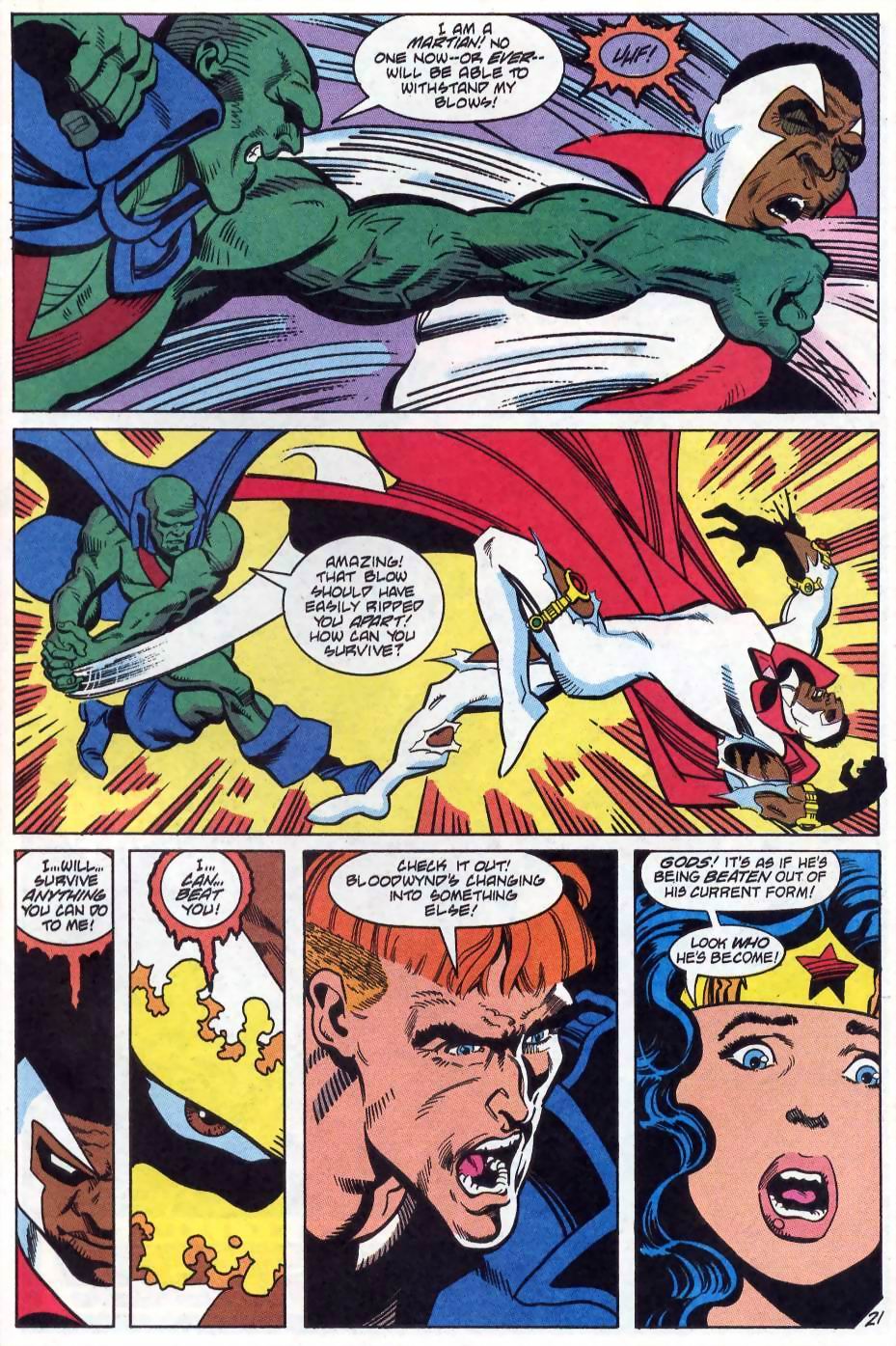

Wonder Woman’s questioning seems uncalled for at a glance. It would be normal for the appearance-changing Bloodwynd to become a Martian Manhunter dupe just to throw the Fascist Leaguers off. The unbalanced Fascist J’Onn would be further provoked by fighting “himself.” No one else would know who to hit.
But the end-of-issue cliffhanger is an admission that there’s more to it than that. Plus Bloodwynd-J’Onn retains the gem and doesn’t have the badge, as he would if he were trying an “attack him, I’m the real one!” strategy. You can also tell he’s the good one because…uh…his skin is lighter. I’m not going to touch that one.
Below is a two-page spread. If you’re having any trouble reading it, here’s a bigger version.

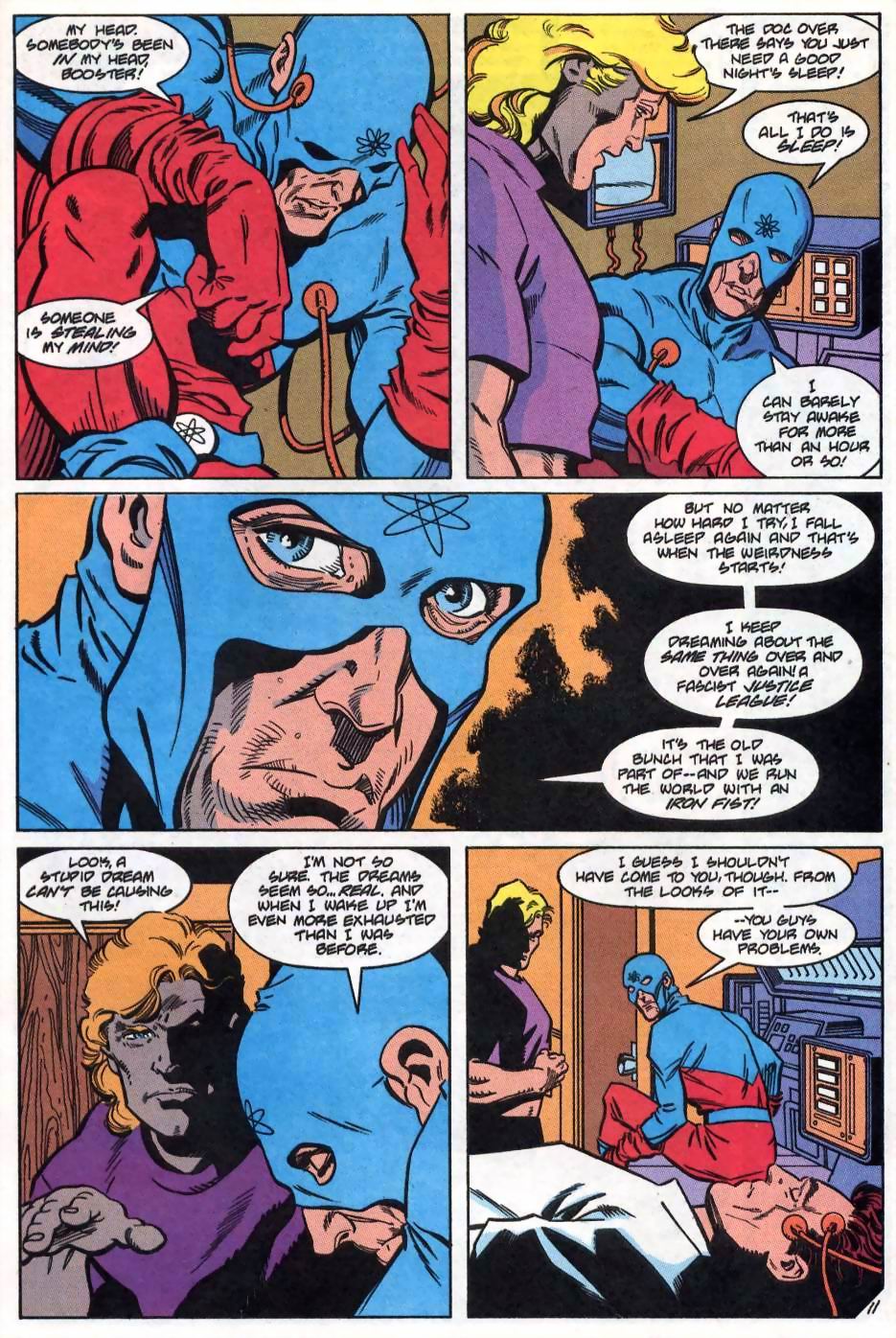
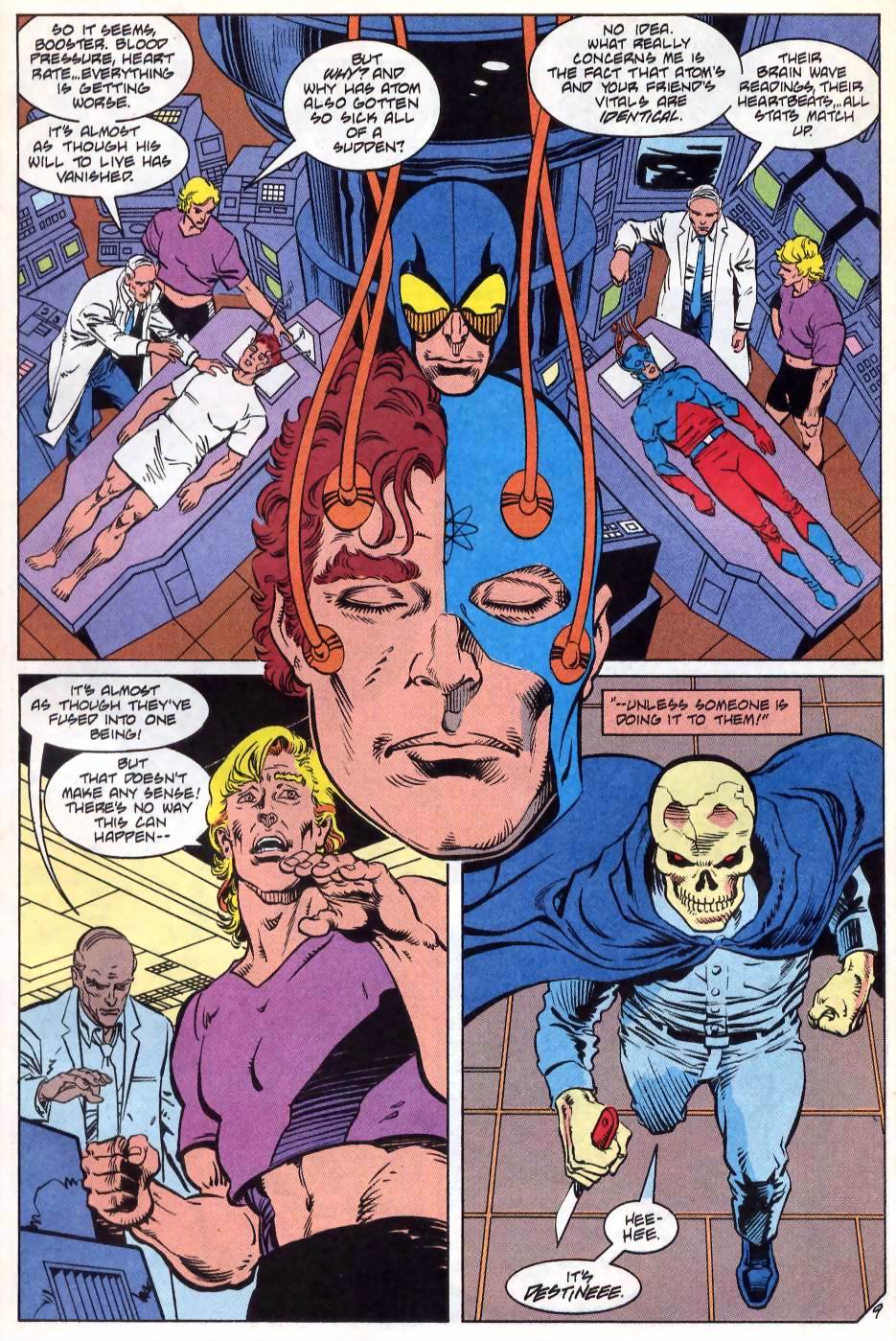
So, basically…Ray Palmer had a bad dream about the League turning fascist, and DD made him dream it over and over until it acquired enough detail and power that DD could start bringing it into reality.
The dream will become “realer” than real reality once Palmer dies, so Destiny is… A) Depositing him into his own dream-reality to kill him. B) Showing him this awful nightmare to strain his heart and kill him. C) Just weakening his vital signs to kill him, he’s already dying in the spread above, no special effort necessary! D) Buying a steak knife at the local Target and getting ready to stab him like a Freddy Krueger who decided he’d rather be a Jason.
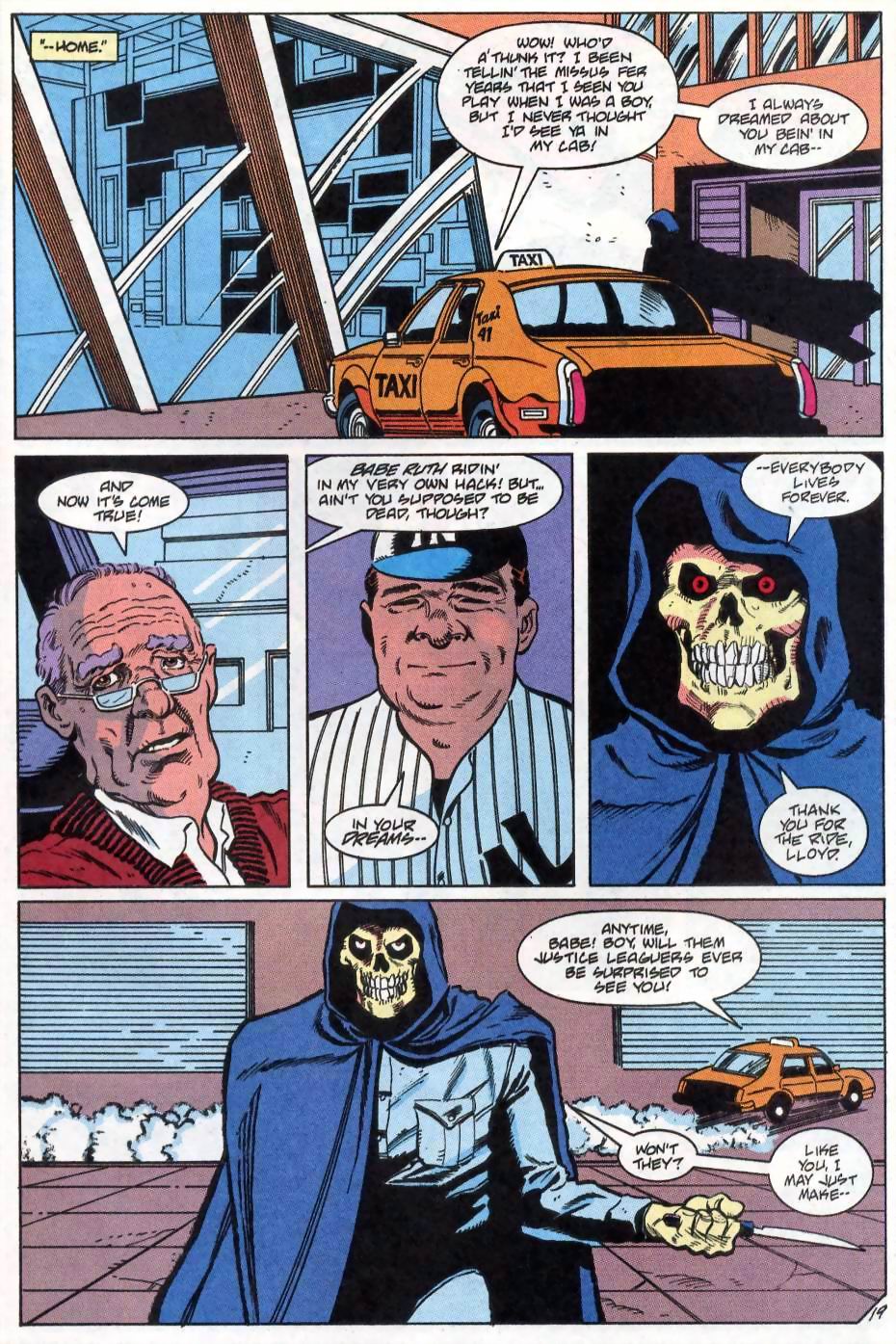
He goes with option D, inducing sleep in Oberon with his sleep-inducing powers and “inducing sleep” in Fire by punching her in the head.
The breakdown between the Fascist League’s dream reality and the real one has some unexpected side effects. Comatose Beetle, lying next to the comatose Atom, can send his dream-self into the superprison, with good and bad results.

Palmer follows suit, overwriting the fascist Atom’s personality with his own. Inside the satellite, he starts bringing its firepower to bear on the superprison, making everything more unstable. Palmer still has to direct the satellite, so he gets Beetle on comms and urges him to will himself to wake up.

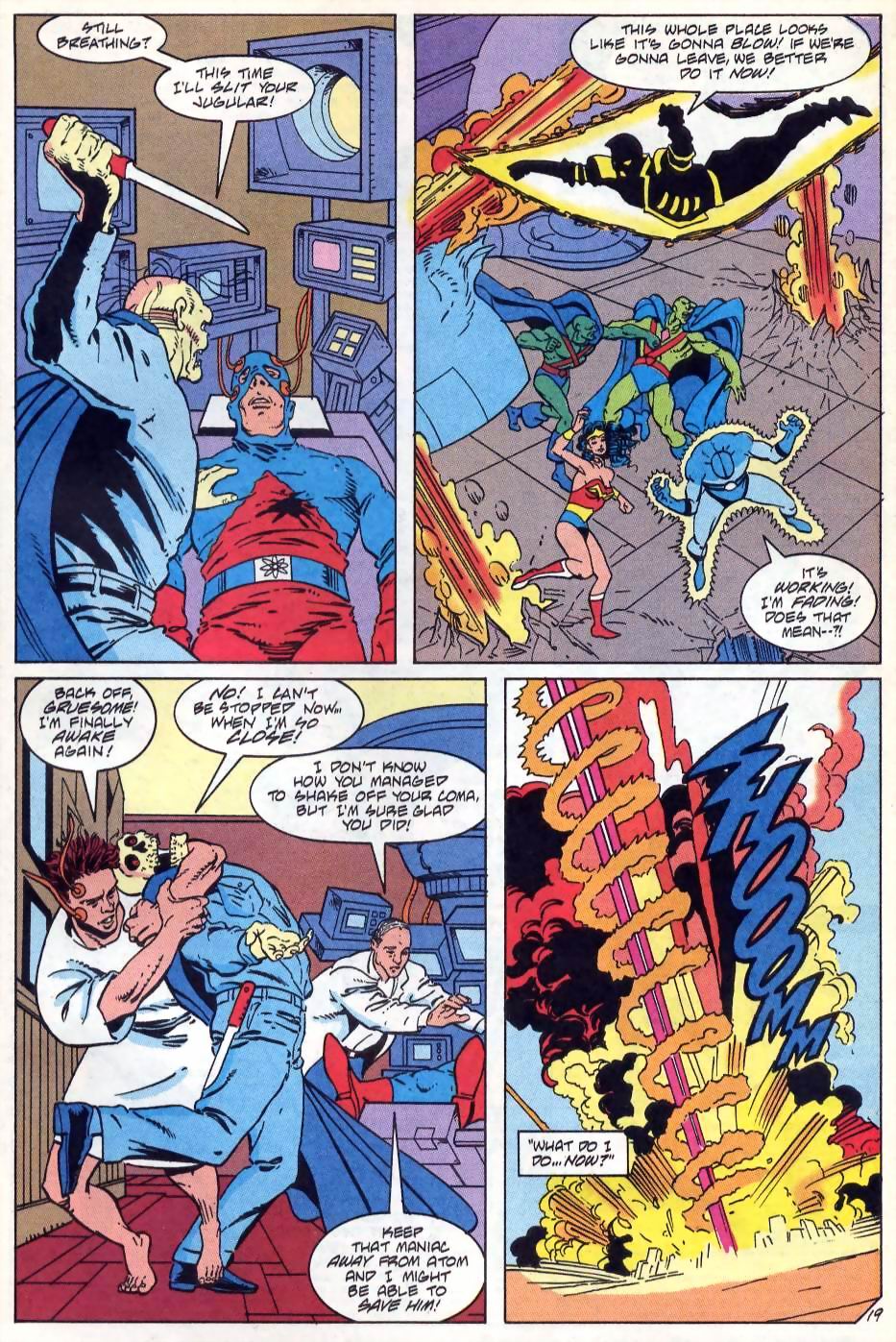

I’d…like to hear Palmer finish unpacking why he thinks Destiny was “more right than wrong.” The good old days weren’t always good and tomorrow’s not as bad as it seems, sure, but outside of maybe ignoring conditions at Arkham Asylum, I don’t think any version of the League was that mean to John Dee, or to super-criminals in general?
But I’ll go along with the shape of the theme here: toxic nostalgia bad, newer heroes deserve a chance, even if they can be goofballs sometimes. Ted comes back to a hero’s welcome, and Wonder Woman’s praise has gotta be good for his impostor syndrome:

This wouldn’t be a bad signoff for Jurgens’ version of the League, but as Beetle says, there’s one more mystery to unpack. Not “who is Bloodwynd,” but “why is Bloodwynd?”

The answer involves two of this run’s unbelievably boring villains, so I’ll minimize their exposure as much as I can. Let’s hit the highlights. First highlight: an intense Beetle going more Rorschach than Nite Owl (#76):

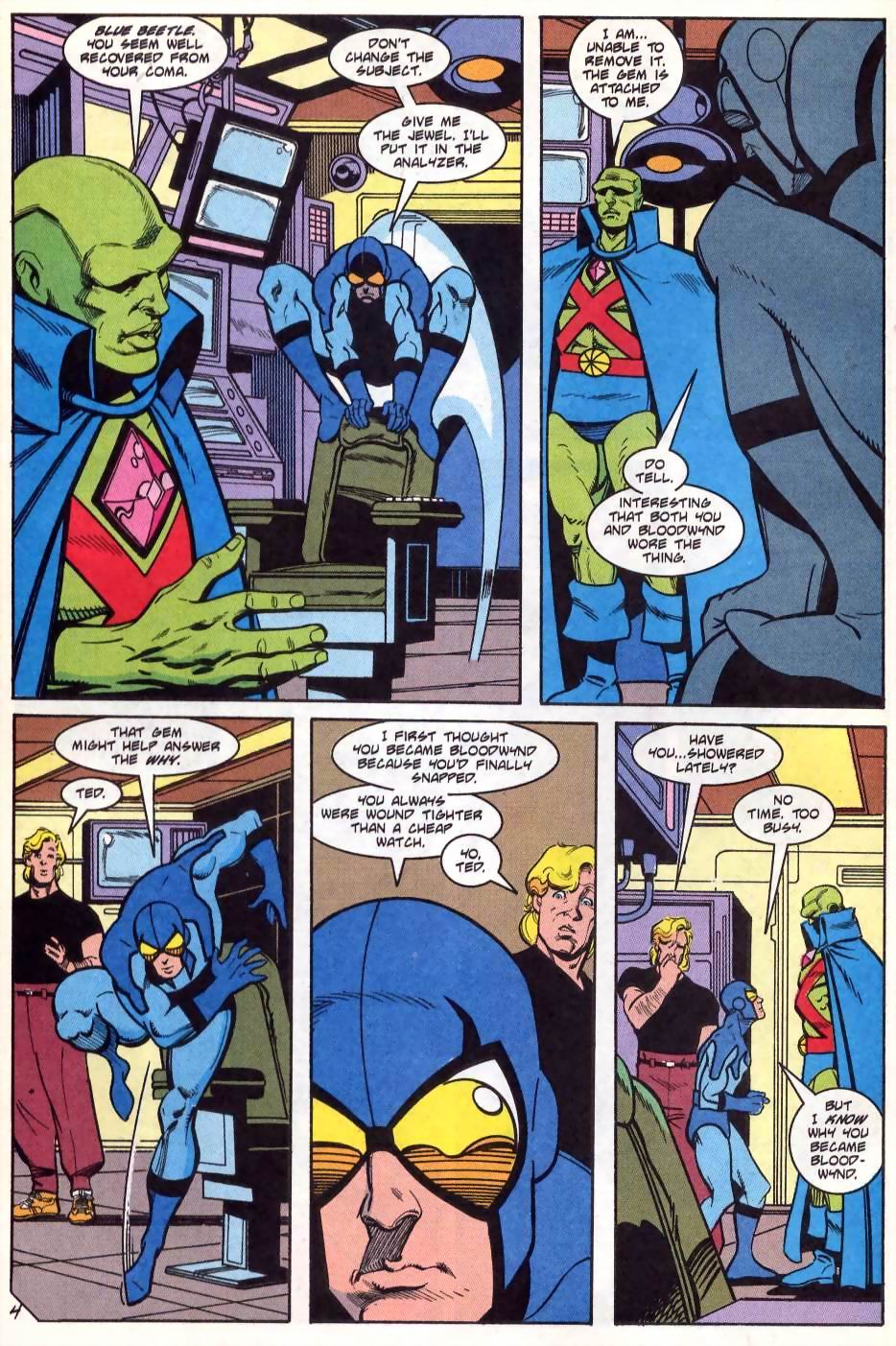
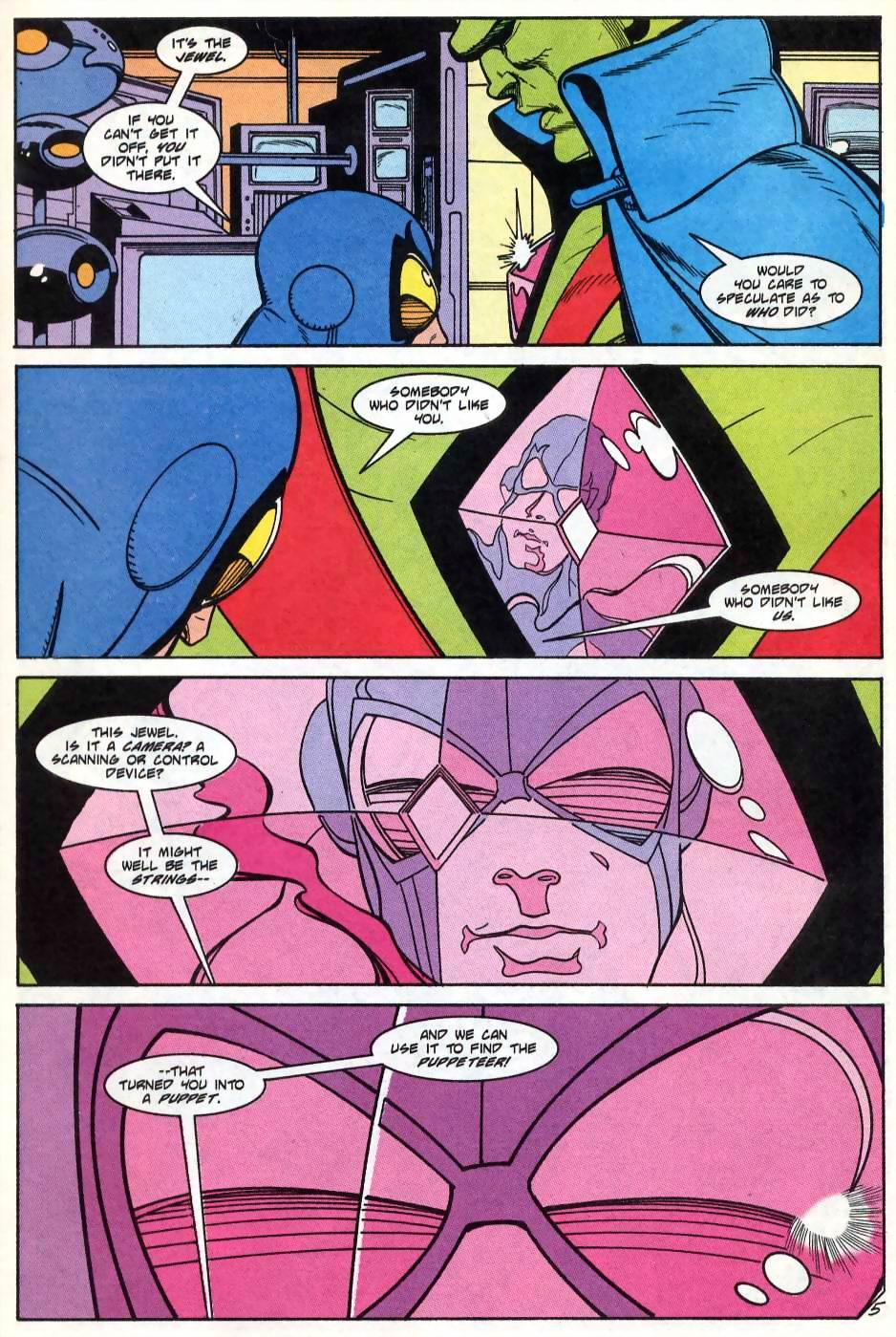
“You always were wound tighter than a cheap watch” is…well, Ted, it’s certainly one way for you to interpret your usual interactions with J’Onn, but I think you could take a little more responsibility there.

Last time for that last panel there, I promise. Second highlight: some grade-A body horror.


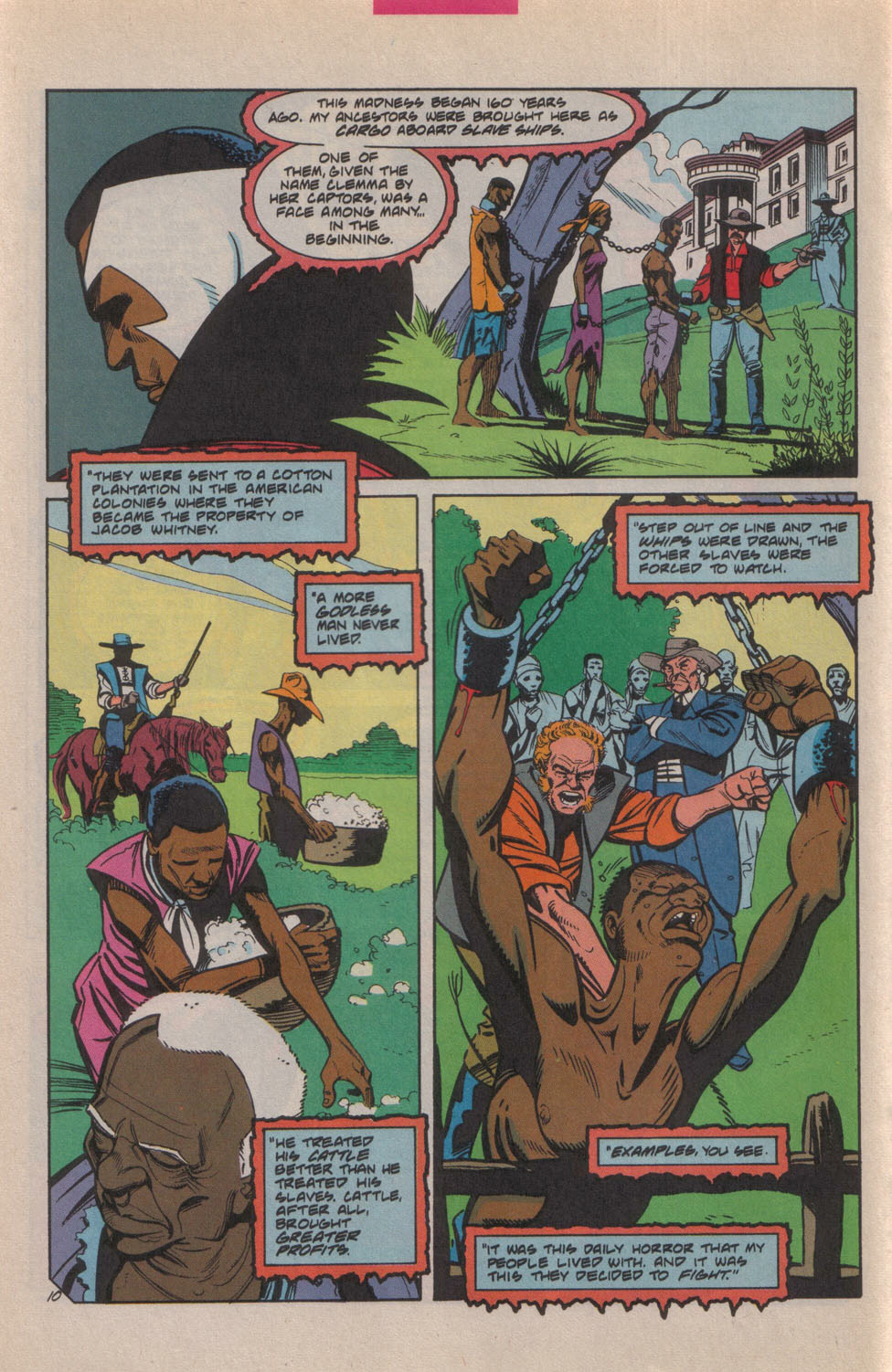
Third highlight (debatable): Bloodwynd’s actual origin. Yes, there was a REAL Bloodwynd J’Onn was impersonating under the instruction of one of the villains, who’s tied to Bloodwynd the way the Void is tied to the Sentry. YMMV on the tale below (#77)...



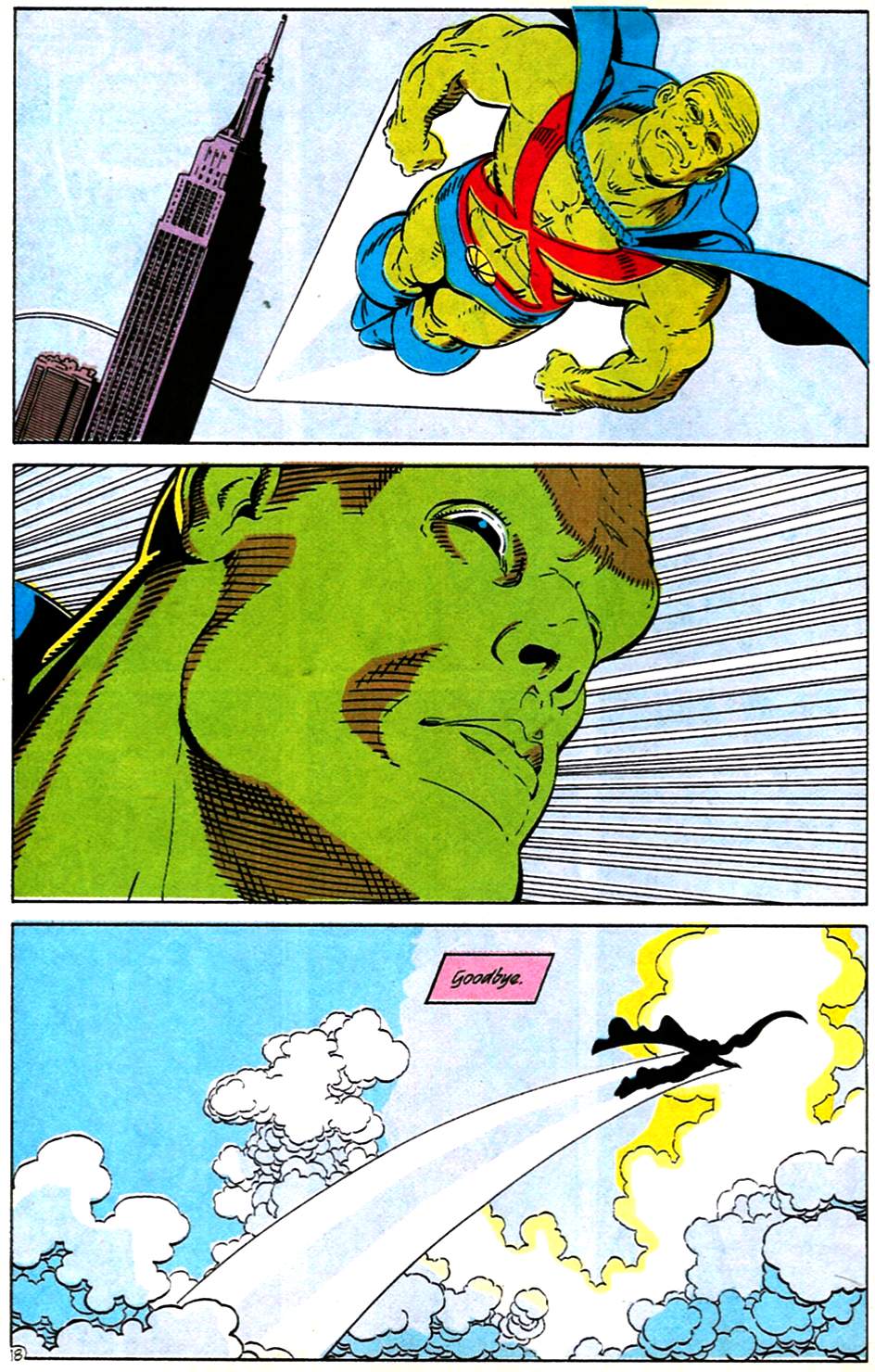
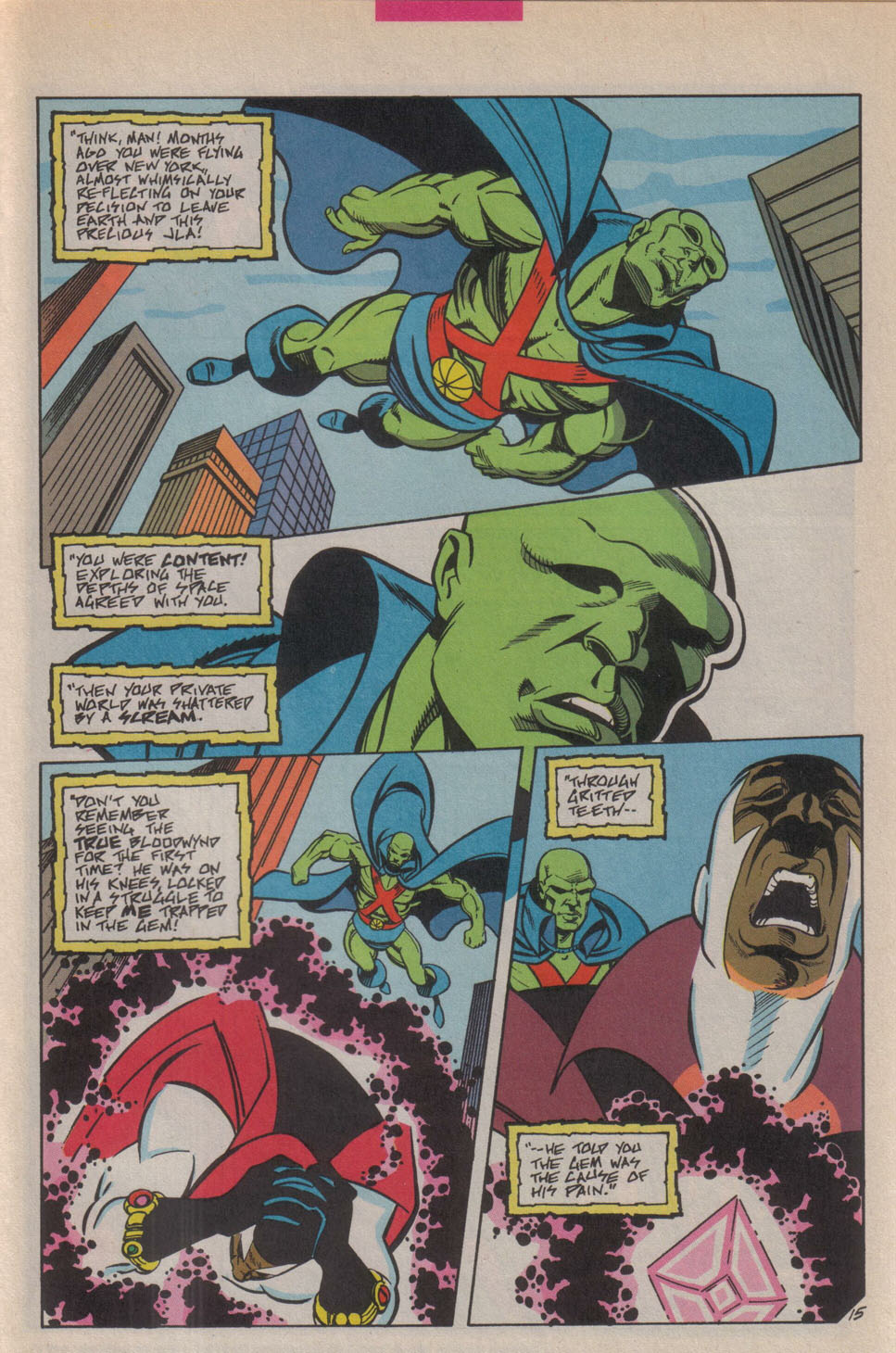
Also, Jurgens demonstrates that he did get around to reading the last issues of the Giffen run eventually, with a callback to #60:
My take: Bloodwynd’s backstory does acknowledge the inhumanity of slavery more than most 20th-century depictions (although it can be read as just “one bad slaveholder”). I don’t have a problem with a depiction of slaves embracing some weird magic to balance the scales a little, as long as it’s not portrayed as any real-world religion. Weird magic’s all over the DC universe anyway, what’s a little more?
That’s the good news. Bad news is, we’ve done such a shuffle on Bloodwynd already…a mysterious NEW character!...who won’t reveal anything about himself for OVER A YEAR!...no, he’s just J’Onn in blackface…no NO, he IS the new guy, but in GREENFACE!...no, actually he’s the new guy’s EVIL TOENAIL SHAVINGS, in greenface!...the readers’ curiosity is more likely exhausted than teased.

Also…we still don’t know anything interesting about Bloodwynd himself. We just know something interesting that his great-great-great-great-grandparents did and that he’s kept up the tradition. Also…WHY “Rott” felt that J’Onn would be better at infiltrating the League as Bloodwynd than as J’ONN J’ONZZ is a question that will likely never be answered. (Also… “Rott.” [heavy sigh])
Bloodwynd would carry on as a Justice Leaguer for another year, but from what I can find, he never got too close to anybody or showed any personal interests. After noping out from one League battle because “the cosmic balance demands that what will be will be” or something to that effect, he left the roster and was relegated to crowd scenes of DC magicians or “Nineties characters” (he’s bottom center in the spread below). After a while, he faded even from those.

He seems like the kind of character who could get a new lease on life with the right creators, probably Black creators. But he could just as easily stay forgotten.
Thus ended Jurgens’ time with this incarnation of the Justice League; next issue would swap him out for another Dan, Dan Vado. Ol’ DJ clearly enjoyed working with Giffen and DeMatteis’ ideas, and he’d return to them many times in his career. But to my mind, he always seemed to struggle to capture that “JLI” tone…

…until his Blue & Gold miniseries of the 2020s, which we’ll sample a bit before we’re done! Meantime, the next couple of updates have turned out to run long like this one did, so I'm going to keep up the daily schedule a bit longer!

Tomorrow: The “international era” of the Justice League (post-Legends, pre-Morrison) dies not with a bang but with a “ha ha, you thought they were gonna BANG?”
When we last left our intrepid heroes, a fascist version of the Bronze Age JLA had taken over its reality, which was bleeding into “ours.” And the late-1993 JLA was getting its asses kicked. Hard. It’s all presented in Jurgens’ usual straightforward way, which gives the evil a chilling banality.
The Atom shows back up on the League’s doorstep in JLA #73-74, but before he can once again tell any current Leaguers that they’re a bunch of losers, he collapses.
Speaking of those losers, Booster and Fire have been hanging out in the basement for the last few issues after concluding that they had no future with the League or as superheroes.
I guess if Max is still giving them room and board, it’s understandable. Most people living in New York would risk regular supervillain attacks just to keep a rent-controlled apartment.
I’m skipping most of the direct League-on-League fights; they’re fun but not the story highlights. Wonder Woman holds her own but surrenders rather than see her teammates killed. Ray and Guy went down to a sneak attack last issue, so Bloodwynd faces a similar choice and picks a different option, vanishing from sight.
He then hooks up with one renegade Fascist Leaguer and a villain sprung from jail. Bloodwynd uses his “mysterious” self-disguising powers (invisibility? Shape-shifting? Who could he be?) to pose as Hawkman and bring the other two in as “prisoners.” They enter the League megaprison where Real Leaguers are being held. The horrific brutality they find there speaks for itself.
There’s another fight. Other than fascism, the Fascist League only differs from the old one in a few ways, but one difference is that Fascist Martian Manhunter is more self-aggrandizing than Charlie Sheen in his “tiger blood” interview. This catches up to him here (to Fash MM, not Sheen)…
Wonder Woman’s questioning seems uncalled for at a glance. It would be normal for the appearance-changing Bloodwynd to become a Martian Manhunter dupe just to throw the Fascist Leaguers off. The unbalanced Fascist J’Onn would be further provoked by fighting “himself.” No one else would know who to hit.
But the end-of-issue cliffhanger is an admission that there’s more to it than that. Plus Bloodwynd-J’Onn retains the gem and doesn’t have the badge, as he would if he were trying an “attack him, I’m the real one!” strategy. You can also tell he’s the good one because…uh…his skin is lighter. I’m not going to touch that one.
Below is a two-page spread. If you’re having any trouble reading it, here’s a bigger version.
So, basically…Ray Palmer had a bad dream about the League turning fascist, and DD made him dream it over and over until it acquired enough detail and power that DD could start bringing it into reality.
The dream will become “realer” than real reality once Palmer dies, so Destiny is… A) Depositing him into his own dream-reality to kill him. B) Showing him this awful nightmare to strain his heart and kill him. C) Just weakening his vital signs to kill him, he’s already dying in the spread above, no special effort necessary! D) Buying a steak knife at the local Target and getting ready to stab him like a Freddy Krueger who decided he’d rather be a Jason.
He goes with option D, inducing sleep in Oberon with his sleep-inducing powers and “inducing sleep” in Fire by punching her in the head.
The breakdown between the Fascist League’s dream reality and the real one has some unexpected side effects. Comatose Beetle, lying next to the comatose Atom, can send his dream-self into the superprison, with good and bad results.
Palmer follows suit, overwriting the fascist Atom’s personality with his own. Inside the satellite, he starts bringing its firepower to bear on the superprison, making everything more unstable. Palmer still has to direct the satellite, so he gets Beetle on comms and urges him to will himself to wake up.
I’d…like to hear Palmer finish unpacking why he thinks Destiny was “more right than wrong.” The good old days weren’t always good and tomorrow’s not as bad as it seems, sure, but outside of maybe ignoring conditions at Arkham Asylum, I don’t think any version of the League was that mean to John Dee, or to super-criminals in general?
But I’ll go along with the shape of the theme here: toxic nostalgia bad, newer heroes deserve a chance, even if they can be goofballs sometimes. Ted comes back to a hero’s welcome, and Wonder Woman’s praise has gotta be good for his impostor syndrome:
This wouldn’t be a bad signoff for Jurgens’ version of the League, but as Beetle says, there’s one more mystery to unpack. Not “who is Bloodwynd,” but “why is Bloodwynd?”
The answer involves two of this run’s unbelievably boring villains, so I’ll minimize their exposure as much as I can. Let’s hit the highlights. First highlight: an intense Beetle going more Rorschach than Nite Owl (#76):
“You always were wound tighter than a cheap watch” is…well, Ted, it’s certainly one way for you to interpret your usual interactions with J’Onn, but I think you could take a little more responsibility there.
Last time for that last panel there, I promise. Second highlight: some grade-A body horror.
Third highlight (debatable): Bloodwynd’s actual origin. Yes, there was a REAL Bloodwynd J’Onn was impersonating under the instruction of one of the villains, who’s tied to Bloodwynd the way the Void is tied to the Sentry. YMMV on the tale below (#77)...
Also, Jurgens demonstrates that he did get around to reading the last issues of the Giffen run eventually, with a callback to #60:
My take: Bloodwynd’s backstory does acknowledge the inhumanity of slavery more than most 20th-century depictions (although it can be read as just “one bad slaveholder”). I don’t have a problem with a depiction of slaves embracing some weird magic to balance the scales a little, as long as it’s not portrayed as any real-world religion. Weird magic’s all over the DC universe anyway, what’s a little more?
That’s the good news. Bad news is, we’ve done such a shuffle on Bloodwynd already…a mysterious NEW character!...who won’t reveal anything about himself for OVER A YEAR!...no, he’s just J’Onn in blackface…no NO, he IS the new guy, but in GREENFACE!...no, actually he’s the new guy’s EVIL TOENAIL SHAVINGS, in greenface!...the readers’ curiosity is more likely exhausted than teased.
Also…we still don’t know anything interesting about Bloodwynd himself. We just know something interesting that his great-great-great-great-grandparents did and that he’s kept up the tradition. Also…WHY “Rott” felt that J’Onn would be better at infiltrating the League as Bloodwynd than as J’ONN J’ONZZ is a question that will likely never be answered. (Also… “Rott.” [heavy sigh])
Bloodwynd would carry on as a Justice Leaguer for another year, but from what I can find, he never got too close to anybody or showed any personal interests. After noping out from one League battle because “the cosmic balance demands that what will be will be” or something to that effect, he left the roster and was relegated to crowd scenes of DC magicians or “Nineties characters” (he’s bottom center in the spread below). After a while, he faded even from those.
He seems like the kind of character who could get a new lease on life with the right creators, probably Black creators. But he could just as easily stay forgotten.
Thus ended Jurgens’ time with this incarnation of the Justice League; next issue would swap him out for another Dan, Dan Vado. Ol’ DJ clearly enjoyed working with Giffen and DeMatteis’ ideas, and he’d return to them many times in his career. But to my mind, he always seemed to struggle to capture that “JLI” tone…
…until his Blue & Gold miniseries of the 2020s, which we’ll sample a bit before we’re done! Meantime, the next couple of updates have turned out to run long like this one did, so I'm going to keep up the daily schedule a bit longer!
Tomorrow: The “international era” of the Justice League (post-Legends, pre-Morrison) dies not with a bang but with a “ha ha, you thought they were gonna BANG?”


