Minmaxing: JLQ #8, Selected JLAs
May. 11th, 2026 06:57 pm![[personal profile]](https://www.dreamwidth.org/img/silk/identity/user.png) tcampbell1000 posting in
tcampbell1000 posting in ![[community profile]](https://www.dreamwidth.org/img/silk/identity/community.png) scans_daily
scans_dailyPart 95a of 105.

Max Lord, as Giffen and DeMatteis conceived him, was a challenging character to work with. They relished that challenge, but their successors often treated him as a problem to minimize or avoid. “Rich manipulator with a heart of gold but moments of egomania and Machiavellianism” can be a tricky balance to strike.
“Double Trouble!,” the Mark Waid/Rod Whigham story from Justice League Quarterly #8, is a welcome exception. It puts Max in a key role and gives him a little of his original villain energy without ignoring his later development. What motivates this Max to flirt with his old manipulative ways? The all-too-human desire to show up his ex.


One thing making this Max a bit better than Mr. Burns is that these are legitimate and attractive offers. (Life-changing, even!) He may be buying out the competition, but at least he’s not trying to do it for cheap.
The breakup of the original Conglomerate and the roster of the League in this story means it has to be after “Breakdowns,” when Max in theory was no longer directing both branches of the League, but Justice League Quarterly continued to treat Max as in charge a lot longer than the other titles did. It’s easy to imagine he called in some favors for this and Superman was too busy with the Parasite or something to object.
Recruitment for new Conglomerate members is not going well.

A despondent Claire is ready to call it quits, but one more applicant brazens his way in and guides her into a knock-knock joke:


Note that the super-people seen above are in the midst of a rescue operation from a natural disaster. Even Claire is not so desperate as to recruit powerful randos with no clue as to their moral alignment, but as she sees them complete their good work, she has Norman pull them through the door and puts her meeting face on.
Max was worried enough about the Conglomerate to play a bit dirty against them, but the Justice Leaguers themselves don’t share those worries. Oddly, none of the Leaguers mention that this used to be Booster’s team. You’d think that’d make things a little awkward, but they just skip right to trash talk.

Instant karma:


Almost all the new Conglomerate members seem to be more powerful versions of the Leaguers who showed up--only the archer Deadeye is a mismatch, facing Power Girl. A visiting Hal Jordan realizes the truth. The new Conglomerate is an old idea in new clothes.

The notion that the Crime Syndicate members were “much more powerful” than their heroic counterparts, instead of an even match for them, is an unusual wrinkle. This was not part of the Silver Age stories, nor is it part of the newer ones. But it seems like it should be! Where’s the suspense in “Oh, no, they’re EXACTLY AS STRONG as we are, we can only defeat them if we find some way to get a .05% advantage”?
Hal zips over to the stadium, where the Syndicate is now abandoning all pretense of sport and just straight up trying to murder the League en masse.


Max is next seen running over to the edge of the stadium, where the Leaguers are being cornered…without Norman. Hal can’t stand up on his own, but he can still point his ring in the right direction, which means the Leaguers have one more team play.

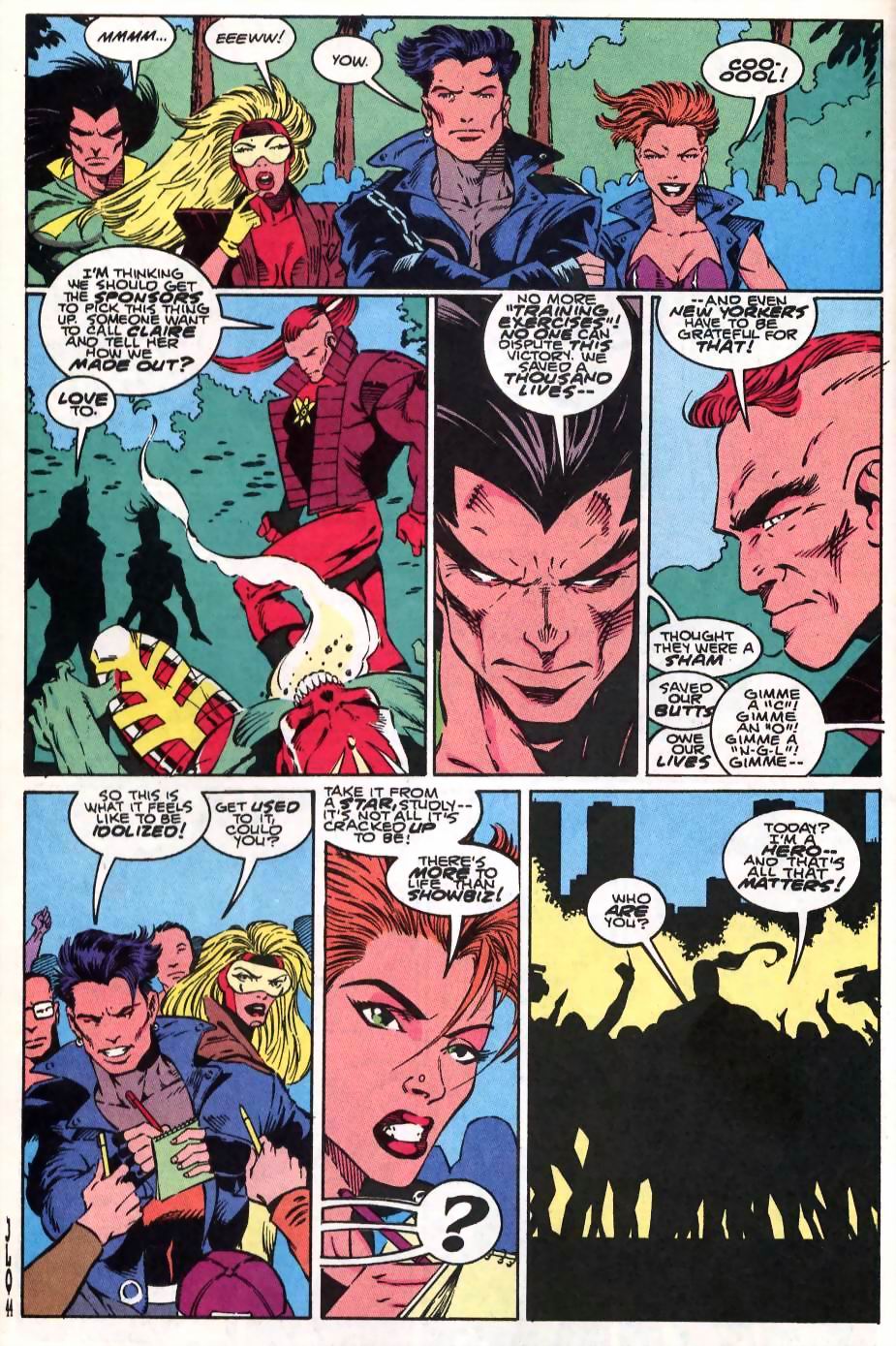
The almost charmingly gullible crowd continues to believe this was all a big show. Without disclosing his role in the original Conglomerate’s dissolution, Max smiles at Claire and tries to make peace. Claire bears him no ill will but is in no mood to celebrate this vetting failure. She figures she’s all washed up, and even when she learns otherwise, she’s not sure that’s good news:

Claire would return with yet a third version of the Conglomerate in JLQ #12, but like this incarnation of the team, it would only last one issue.
One of Giffen's best ideas was to acknowledge someone like Max might be necessary. Someone's got to keep the lights on, keep politicians at bay, make sure the super-team can eat, pay the inevitable medical bills, organize recruitment, arrange housing...the list goes on and on. In most super-teams, details like this just "get handled," or else someone like Reed Richards or Tony Stark deals with it on their lunch break. I'm sure Tony can balance an operating budget and Reed can invent something profitable, but neither are known for the people skills that administration also requires.
You rarely see a character who makes off-battlefield hero-support their primary job, especially now that Alfred’s dead and Barbara’s mostly out of the chair (Nightwing v2 #86).

And even those guys had "Bruce pays for everything" to fall back on.
A weird strain of nerd culture wants to deny the necessity of such “boring ADULT” things as logistical support. And if you do that, then Max has no purpose. Post-Giffen JLA often seems to ask, “Why do our heroes put up with this self-aggrandizing tycoon again? It’s not like they NEED him for anything” (JLA #86, #90, #93).


Quick, Wally! Punch him out before he offers you HEALTH INSURANCE!
In the Giffen League, Max was one of “our heroes,” as much a protagonist as J’Onn J’Onzz or Blue Beetle, facing his own challenges and moral conflicts, not just facilitating the costumed heroes’ arcs. Even Alfred didn’t get that much attention on average. Soon after Giffen and DeMatteis left, Max lost that status, and nobody seemed quite clear on what to do with him after that.
He came down with a brain ailment, implicitly related to his powers. Then he died from it. Then he came back as a brain in a robot body, which…doesn’t seem like it would address that problem, but somehow did? His last appearance in the series that introduced him mirrored the villain energy of his first--he straight-up killed some villain to take charge of the gang she belonged to, steering them toward unknown goals (#94, #95, #111).

Max's chronological next appearance would be eight years later, at which point "the Arcana" were no longer a concern, and his conscience would be back to its normal level...for a little while longer.
Maybe he just broke bad for a bit in response to the callousness of the hospital he ended up in. There’s having a rotten bedside manner, and then there’s quoting Dan Quayle at your doomed patients: “What a waste it is to lose one’s mind…or not to have a mind. How true that is!”
Thursday: Two seemingly incompatible versions of Max foreshadow his later development. It seems John Ostrander just didn’t see eye to eye with…John Ostrander?
Max Lord, as Giffen and DeMatteis conceived him, was a challenging character to work with. They relished that challenge, but their successors often treated him as a problem to minimize or avoid. “Rich manipulator with a heart of gold but moments of egomania and Machiavellianism” can be a tricky balance to strike.
“Double Trouble!,” the Mark Waid/Rod Whigham story from Justice League Quarterly #8, is a welcome exception. It puts Max in a key role and gives him a little of his original villain energy without ignoring his later development. What motivates this Max to flirt with his old manipulative ways? The all-too-human desire to show up his ex.
One thing making this Max a bit better than Mr. Burns is that these are legitimate and attractive offers. (Life-changing, even!) He may be buying out the competition, but at least he’s not trying to do it for cheap.
The breakup of the original Conglomerate and the roster of the League in this story means it has to be after “Breakdowns,” when Max in theory was no longer directing both branches of the League, but Justice League Quarterly continued to treat Max as in charge a lot longer than the other titles did. It’s easy to imagine he called in some favors for this and Superman was too busy with the Parasite or something to object.
Recruitment for new Conglomerate members is not going well.
A despondent Claire is ready to call it quits, but one more applicant brazens his way in and guides her into a knock-knock joke:
Note that the super-people seen above are in the midst of a rescue operation from a natural disaster. Even Claire is not so desperate as to recruit powerful randos with no clue as to their moral alignment, but as she sees them complete their good work, she has Norman pull them through the door and puts her meeting face on.
Max was worried enough about the Conglomerate to play a bit dirty against them, but the Justice Leaguers themselves don’t share those worries. Oddly, none of the Leaguers mention that this used to be Booster’s team. You’d think that’d make things a little awkward, but they just skip right to trash talk.
Instant karma:
Almost all the new Conglomerate members seem to be more powerful versions of the Leaguers who showed up--only the archer Deadeye is a mismatch, facing Power Girl. A visiting Hal Jordan realizes the truth. The new Conglomerate is an old idea in new clothes.
The notion that the Crime Syndicate members were “much more powerful” than their heroic counterparts, instead of an even match for them, is an unusual wrinkle. This was not part of the Silver Age stories, nor is it part of the newer ones. But it seems like it should be! Where’s the suspense in “Oh, no, they’re EXACTLY AS STRONG as we are, we can only defeat them if we find some way to get a .05% advantage”?
Hal zips over to the stadium, where the Syndicate is now abandoning all pretense of sport and just straight up trying to murder the League en masse.
Max is next seen running over to the edge of the stadium, where the Leaguers are being cornered…without Norman. Hal can’t stand up on his own, but he can still point his ring in the right direction, which means the Leaguers have one more team play.
The almost charmingly gullible crowd continues to believe this was all a big show. Without disclosing his role in the original Conglomerate’s dissolution, Max smiles at Claire and tries to make peace. Claire bears him no ill will but is in no mood to celebrate this vetting failure. She figures she’s all washed up, and even when she learns otherwise, she’s not sure that’s good news:
Claire would return with yet a third version of the Conglomerate in JLQ #12, but like this incarnation of the team, it would only last one issue.
One of Giffen's best ideas was to acknowledge someone like Max might be necessary. Someone's got to keep the lights on, keep politicians at bay, make sure the super-team can eat, pay the inevitable medical bills, organize recruitment, arrange housing...the list goes on and on. In most super-teams, details like this just "get handled," or else someone like Reed Richards or Tony Stark deals with it on their lunch break. I'm sure Tony can balance an operating budget and Reed can invent something profitable, but neither are known for the people skills that administration also requires.
You rarely see a character who makes off-battlefield hero-support their primary job, especially now that Alfred’s dead and Barbara’s mostly out of the chair (Nightwing v2 #86).
And even those guys had "Bruce pays for everything" to fall back on.
A weird strain of nerd culture wants to deny the necessity of such “boring ADULT” things as logistical support. And if you do that, then Max has no purpose. Post-Giffen JLA often seems to ask, “Why do our heroes put up with this self-aggrandizing tycoon again? It’s not like they NEED him for anything” (JLA #86, #90, #93).
Quick, Wally! Punch him out before he offers you HEALTH INSURANCE!
In the Giffen League, Max was one of “our heroes,” as much a protagonist as J’Onn J’Onzz or Blue Beetle, facing his own challenges and moral conflicts, not just facilitating the costumed heroes’ arcs. Even Alfred didn’t get that much attention on average. Soon after Giffen and DeMatteis left, Max lost that status, and nobody seemed quite clear on what to do with him after that.
He came down with a brain ailment, implicitly related to his powers. Then he died from it. Then he came back as a brain in a robot body, which…doesn’t seem like it would address that problem, but somehow did? His last appearance in the series that introduced him mirrored the villain energy of his first--he straight-up killed some villain to take charge of the gang she belonged to, steering them toward unknown goals (#94, #95, #111).
Max's chronological next appearance would be eight years later, at which point "the Arcana" were no longer a concern, and his conscience would be back to its normal level...for a little while longer.
Maybe he just broke bad for a bit in response to the callousness of the hospital he ended up in. There’s having a rotten bedside manner, and then there’s quoting Dan Quayle at your doomed patients: “What a waste it is to lose one’s mind…or not to have a mind. How true that is!”
Thursday: Two seemingly incompatible versions of Max foreshadow his later development. It seems John Ostrander just didn’t see eye to eye with…John Ostrander?


no subject
Date: 2026-05-12 03:22 am (UTC)(" The Syndicate all have their characteristic Qwardians eyes covered except for ' Metamorpho ', who's clearly physically transformed " is a detail Waid probably mentioned in the script.)
no subject
Date: 2026-05-12 03:26 am (UTC)no subject
Date: 2026-05-12 03:45 am (UTC)no subject
Date: 2026-05-12 09:44 am (UTC)